


Buyer’s guide
“How many mAh power bank do I need?” is the first question most people ask, and the honest answer depends on three things: your phone’s battery size, how many days you go without a socket, and how much weight you are happy to carry. This guide turns the big numbers on the box into real phone charges, so you can pick the right size the first time.
1.5–2charges from 10,000mAh
3–4charges from 20,000mAh
37Wh / 74Whenergy in each size
In this guide
📱
Most phones today have a 4,000–5,000mAh battery.
🔋
A power bank never gives its full rated mAh to your phone.
🎒
20,000mAh is roughly twice the weight of a slim 10,000mAh model.
01Step 1: turn mAh into real phone charges
The mAh number on a power bank describes the battery cells inside it, measured at about 3.7 volts. Your phone charges at 5 volts or more, so the power bank has to convert the voltage, and some energy is lost as heat along the way. In practice, a power bank delivers about 60–70% of its rated mAh to your phone.
10,000mAhrated cell capacity
→
~6,400mAhusable at 5V
→
1.5–2charges for a 4,500mAh phone
A quick rule you can use in the shop: multiply the power bank’s mAh by 0.65 and divide by your phone’s battery size. For a 5,000mAh phone and a 10,000mAh power bank, that is 10,000 × 0.65 ÷ 5,000 = about 1.3 full charges. For a 4,000mAh phone it is about 1.6 charges. Our guide on how to compare product specifications explains why every brand loses some capacity in conversion.
💡
Look for the “rated capacity”. Good brands print it on the back. The Ronin Neutron R-4030, for example, lists 10,000mAh at 3.7V and 6,400mAh rated at 5V, which tells you exactly what reaches your phone.
0210,000mAh vs 20,000mAh at a glance
10,000mAh
- About 1.5–2 phone charges
- Pocket-friendly, around 200g
- Refills overnight or faster with fast input
- Best for daily carry
VS
20,000mAh
- About 3–4 phone charges
- Bag-sized, roughly double the weight
- Takes longer to refill on a 2A charger
- Best for travel and long power cuts
Neither size is “better”. A 10,000mAh power bank is the one you will actually carry every day. A 20,000mAh model is the one you are glad to have on a long bus journey or when the electricity is out for most of the evening.
03How many mAh power bank do I need for my routine?
🎓
Students and office workers
You charge your phone at home and need a top-up in the afternoon. A slim 10,000mAh like the Links 313 mini is light enough to forget it is in your bag.
Pick: 10,000mAh🚌
Commuters and riders
You are out all day and use maps, calls and WhatsApp heavily. A 10,000mAh with built-in cables, such as the J-Cell J-122, saves you carrying wires.
Pick: 10,000mAh + cables🏔️
Travellers and families
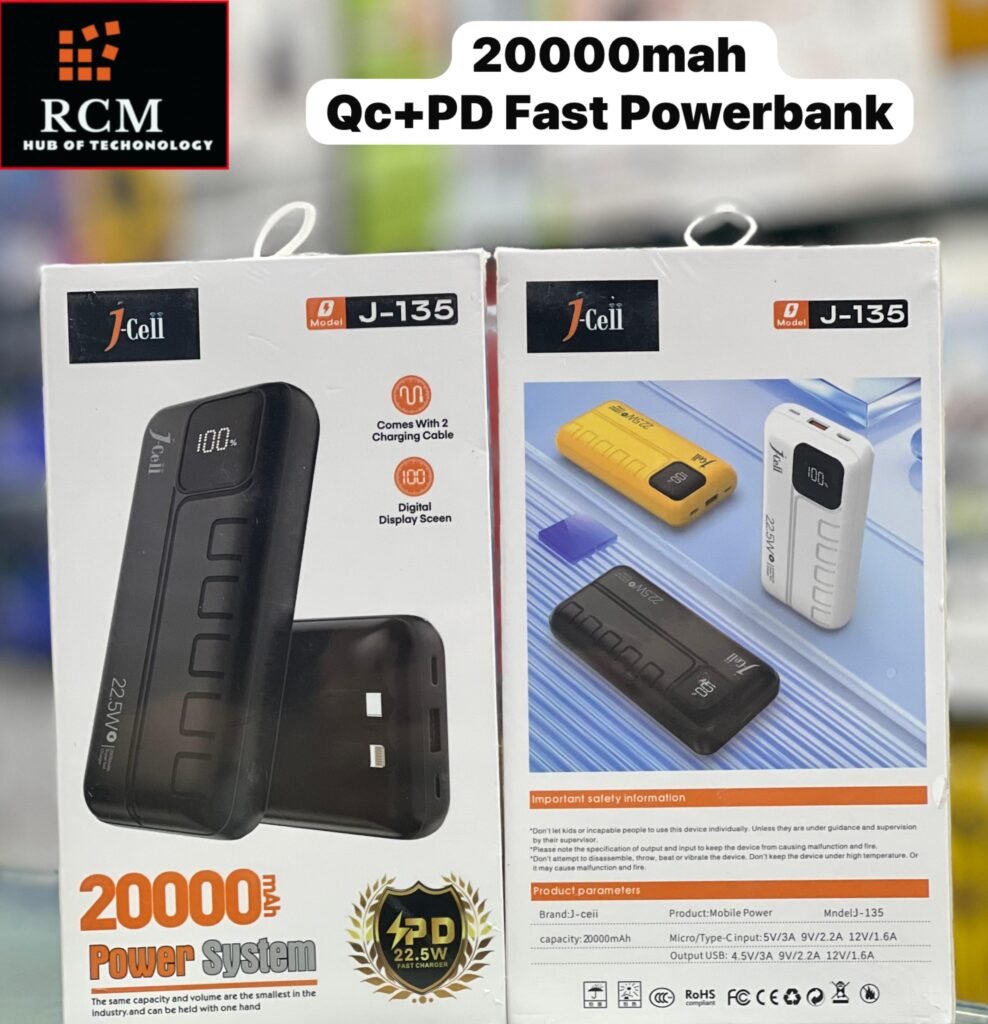
Long journeys, hotel rooms with one socket, or two phones to charge. The J-Cell J-135 20,000mAh covers 3–4 charges and has three built-in cables.
Pick: 20,000mAh⚡
People who want speed
If you charge in short breaks, speed matters more than size. The J-Cell J-102 supports PD fast charging, so a short top-up adds more battery.
Pick: 10,000mAh fast04Planning for load-shedding
If your area has two or three hours of load-shedding at a time, a 10,000mAh power bank is usually enough to keep one phone going. If you face long evening outages and several family members share one power bank, a 20,000mAh model makes more sense, because it can top up two or three phones in one go.
Remember that the power bank also needs time to refill. A 20,000mAh power bank on a standard 2A input can take most of a night to charge, so plug it in as soon as the power comes back. Our load-shedding power bank guide covers this in more detail.
05Air travel and the 100Wh limit
Airlines measure power banks in watt-hours (Wh), not mAh. To convert, multiply mAh by 3.7 and divide by 1,000. A 10,000mAh power bank is about 37Wh and a 20,000mAh model is about 74Wh, so both are under the common 100Wh limit for carry-on bags. Power banks must go in your hand luggage, never in checked bags. Read more in our guide to taking a power bank on a plane.
06Other things to check besides mAh
Output speedStandard 2A or fast PD/QC?
Input portType-C refills faster than Micro USB
Built-in cablesHandy, but check they match your phone
DisplayA digital % display beats four LEDs
WeightHold it before you buy if you carry it daily
BrandNamed brands state real ratings
⚠️
Be careful with very cheap “50,000mAh” claims. A genuine 50,000mAh power bank is large and heavy. If a pocket-sized unit claims huge capacity at a low price, the number is almost certainly not real.
For background on how they work, see the power bank article on Wikipedia.
Key takeaway
For most people, a 10,000mAh power bank is the right everyday size and gives 1.5–2 phone charges. Choose 20,000mAh only if you travel often, share it with family or sit through long power cuts.
🛒Shop the products in this guide
-
Power Banks
J-Cell J-102 10000mAh Transparent Power Bank (PD 66W, 4-in-1 Cable)
Original price was: ₨ 3,399.₨ 2,799Current price is: ₨ 2,799. Add to cart -
Power Banks
J-Cell J-135 20000mAh Power Bank with Built-in Cables
Original price was: ₨ 4,999.₨ 4,499Current price is: ₨ 4,499. Read more -
Power Banks
Links 313 LK-126 Mini 10000mAh Power Bank
Original price was: ₨ 2,999.₨ 2,199Current price is: ₨ 2,199. Read more -
Power Banks
Ronin Neutron R-4030 10000mAh Power Bank (22.5W)
Original price was: ₨ 6,595.₨ 5,999Current price is: ₨ 5,999. Read more
07Frequently asked questions
How many times will a 10,000mAh power bank charge my phone?
About 1.5–2 times for a phone with a 4,000–5,000mAh battery, because roughly a third of the energy is lost in conversion.
Is a 20,000mAh power bank too heavy to carry daily?
It is usually around twice the weight of a slim 10,000mAh model. Many people find it fine in a bag but too heavy for a pocket.
Is a bigger power bank bad for my phone?
No. Your phone only takes the current it needs, so a larger power bank simply lasts longer. Speed is decided by the charging standard, not the capacity.
Can I take a 20,000mAh power bank on a plane?
Usually yes, in hand luggage only, because it is about 74Wh, under the common 100Wh limit. Always check your airline’s latest rules.

Mobile Accessories

Neckband vs Earbuds: Which Is Better for You?
Neckbands last longer and are hard to lose; earbuds are compact and stylish. Here is how they compare for commuters, riders, students and gym users.

Device Care & Maintenance
Why Is My Phone Charging Slowly? 10 Causes and Simple Fixes
From lint in the port to the wrong charger, here are the most common reasons a phone charges slowly and how to fix each one in minutes.

Device Care & Maintenance
One Earbud Not Working? How to Fix Left or Right Earbud Problems
Only the left or right earbud playing? Most cases are fixed in minutes with these steps, from cleaning the charging contacts to a full reset.